

Most of us were taught to draw our life paths in straight lines: graduate, specialize, climb the ladder, retire. But look around — the world no longer rewards rigidity. In an era of accelerating change and personal redefinition, the straight path is not only outdated — it’s limiting.
Welcome to the zig-zag life — a concept championed by bestselling author Daniel Pink and grounded in new research on motivation, identity, and success. The zig-zag life isn’t a fallback for the indecisive. It’s a strategy for those bold enough to let happiness, fulfillment, meaning, and joy rather than predictability, be their compass.
The Darkhorse Mindset: A Case for Personal Fit
At the Harvard Graduate School of Education, researchers Todd Rose and Ogi Ogas launched the Darkhorse Project, studying people who achieved extraordinary success by prioritizing personal fulfillment over traditional plans. They didn’t follow a grand strategy. Instead, they made small, intentional decisions aligned with what motivated them deeply — what Rose calls their “micro-motives.”¹
This approach defies the myth that success requires staying in your lane. The best lives, like the best investments, adapt to context.
Daniel Pink’s Book of Experiments
In a recent LinkedIn post, Daniel Pink urges people to abandon rigid long-term goals and instead keep a “Book of Experiments.” Try things. Track what brings energy. Adjust. Repeat.
This isn’t aimless wandering. It’s strategic iteration — the life equivalent of A/B testing with your soul. It aligns with what David Epstein wrote in Range: people who explore broadly and delay specialization often outperform early specialists.² The reason? They achieve match quality — the degree of fit between who they are and what they do.
Investment Charts as Life Metaphors
To visualize the zig-zag life, we might borrow from the world of investment analysis. Two technical tools—Elliott Wave Theory and Point and Figure charts—offer surprisingly apt metaphors for how people grow, pivot, and thrive.
Elliott Wave Theory
Developed by Ralph Nelson Elliott in the 1930s, this charting method holds that markets move in psychological waves: *five steps forward, three steps back.*³ This cyclical motion mirrors the life path of the fulfilled generalist. You surge forward into a new challenge (Wave 1), hit resistance (Wave 2), push further as mastery deepens (Wave 3), reflect or correct (Wave 4), then break through (Wave 5). Setbacks aren’t failures — they’re vital feedback loops.
Point and Figure Charts
Point and Figure (P&F) charts simplify complexity. They ignore time entirely and record only meaningful movements — ignoring noise in favor of clarity.⁴ Life, too, is better understood through decisive inflection points, not endless to-do lists. These are the moments you quit, start over, say yes to something terrifying — and they define you more than the months of drifting in between.
Visualizing the Zig-Zag Life
The chart below captures this double metaphor:
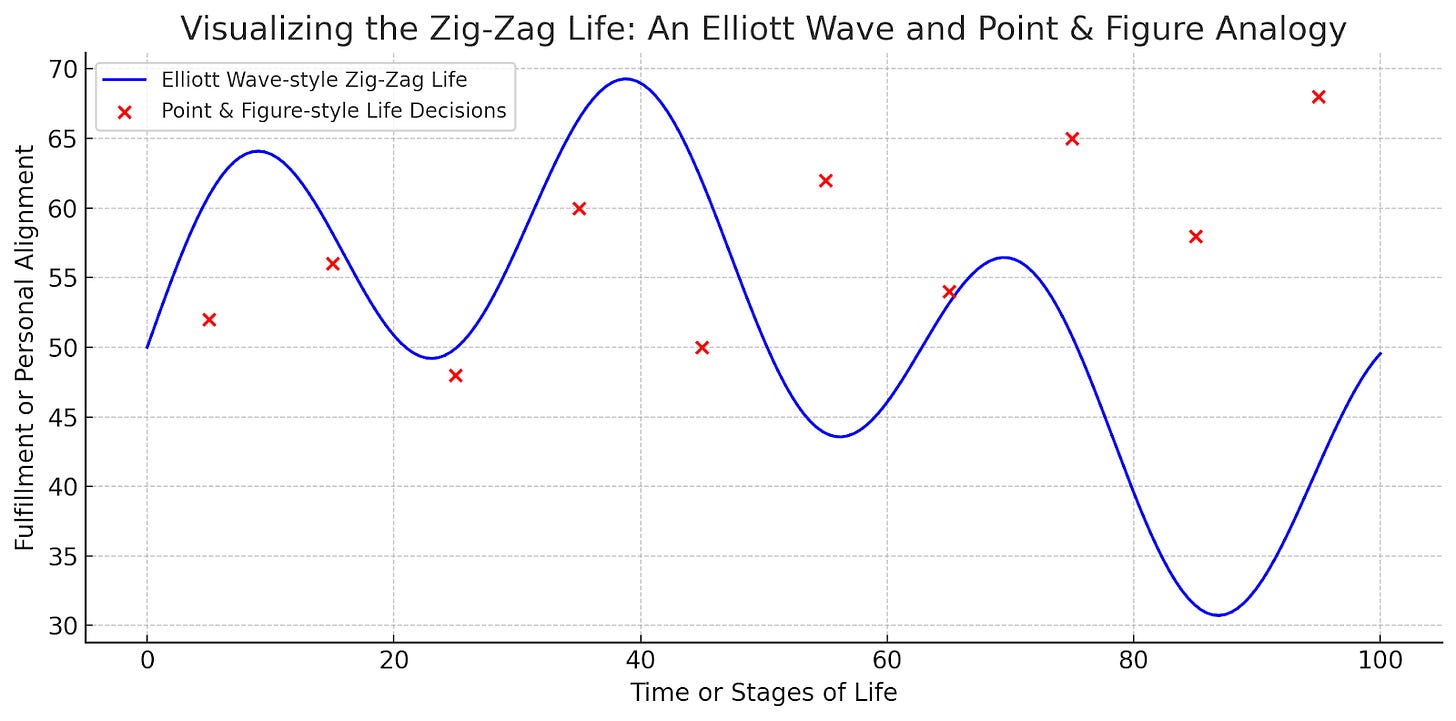
The blue wave represents the Elliott Wave-like progression of a zig-zag life—marked by surges of growth, intentional pauses, and renewals.
The red dots represent Point and Figure-style decision markers—critical inflection points like career changes, pivots, or reinventions.
The blue wave is your evolving fulfillment — shaped by experimentation, correction, and renewed purpose.
The red dots show life’s real milestones: moments of reinvention, risk, or reorientation.
The zig-zag life doesn’t reject achievement — it redefines it. It asks: Is this path truly mine? It favors those who reflect, redirect, and re-engage with curiosity. It demands that we ask better questions: What energizes me now? What has changed in the world, and how do I respond?
In a world of volatility, uncertainty, complexity, and ambiguity, the best strategy might not be control — but course correction. If we can embrace the zig-zag life, we’ll not only find more success. We’ll find more meaning, happiness, and joy.
Footnotes
Rose, T., & Ogas, O. (2019). Dark Horse: Achieving Success Through the Pursuit of Fulfillment. HarperOne.
Epstein, D. (2019). Range: Why Generalists Triumph in a Specialized World. Riverhead Books.
Frost, A. J., & Prechter, R. R. (2005). Elliott Wave Principle: Key to Market Behavior. Wiley.
Dorsey, T. (2007). Point and Figure Charting: The Essential Application for Forecasting and Tracking Market Prices. Wiley.