
The Baja shoreline where I walk is dynamic. To me it is an endless symphony of waves breaking and the tide ebbing and flowing. I hear the rhythmic crunch of sand, rocks, and small shells under my feet. I watch the light, the sky, and the water of the Pacific in its countless shades of blue, green, and gray. Most of us walk this sometimes subtle, sometimes mind-blowing environment in what I might call a “scrolling” or “browsing” state of mind. We notice a wave breaking, then a seagull searching for a meal, then the tide lapping at our feet, then a shell half-buried in the sand, then sand crabs disappearing into their holes. Our minds are open, unfocused, and slightly overstimulated. Our attention never quite settles.
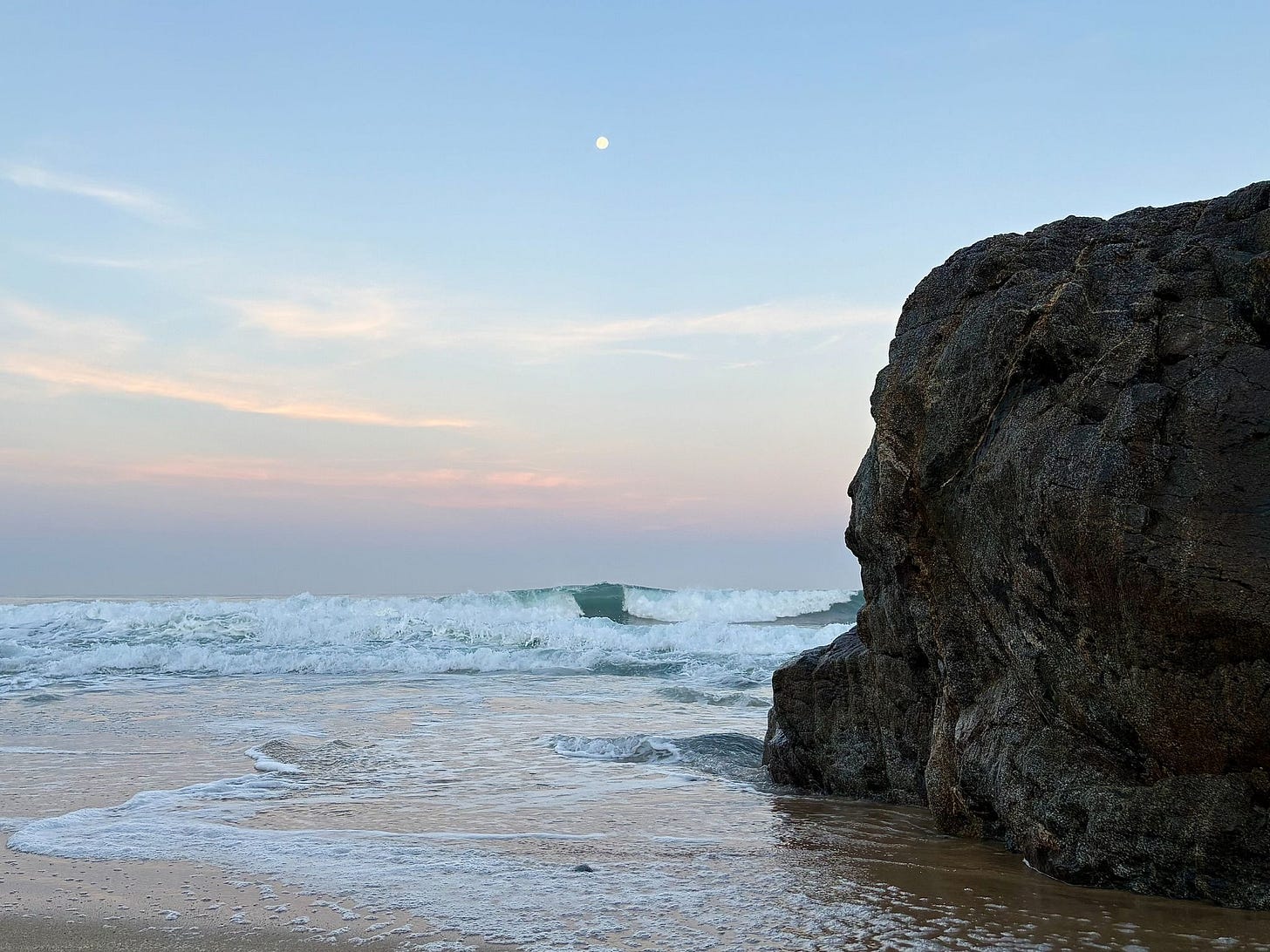
But the moment I notice and pick up a single, geologically sculpted rock, my world narrows. The restless browsing ceases and I shift into a more focused mode. I have embarked on a bounded quest: how might this rock balance on top of another? Which rock might I pair with it? Daniel Berlyne would call the first state diversive curiosity and the second specific curiosity. The distance between them is the topic I want to unpack here.
I have practiced rock balancing for years. (I’ll make a quick distinction: rock balancing is getting a rock to stand unsupported on top of another rock in its least likely postion. Rock “stacking” is arranging rocks on top of each other so that they look attractive). This activity resists staleness for me because the seashore never repeats itself exactly. The receding tide, the angle of the Baja sun, and the particular rocks I find on any given day are a configuration that will never exist again. Rock balancing has become for me not a hobby but a daily ritual for practicing the art of sitting with the unknown. We live in a world defined by volatility, uncertainty, complexity, and ambiguity. In such an environment my mind seeks to retreat into the familiar. A ritual like this one offers a structured way to practice navigating chaos, turning the messy uncertainty into a moment of clear, focused engagement. The move from the vastness of the shoreline to the weighted reality of two rocks is my shift from scrolling to seeking.
A Question Below Language
When I lift a rock I am holding what George Loewenstein defined as an information gap: an awareness that I do not know something, a sense of the possible answers, and no way to tell which is true. What matters to me is not that the gap exists but where it exists. The rock is a question posed entirely below the level of language.
Most of my inquiries in life are propositional. I ask in words and I answer in words. The words are accommodating. They let me rehearse an answer without ever testing it, mistake fluency for understanding, and be persuaded by my own phrasing. In contrast, a rock will not accept a plausible argument. It does not care how well I have described the problem to myself.
So the hypothesis is made with my hands. Every orientation I try is a proposition offered to gravity, and gravity rules on it immediately and without any interest in my reasoning. I am not asking “where is the balance point?” in words. I am searching for it through touch and feel. The center of gravity is a truth hidden inside the rock’s form; and the only instruments fine enough to find it are my fingertips.
The physics is more specific than it sounds. A rock balances on another when it makes three points of contact. On irregular surfaces those three points are often too small to see. What my hands are hunting for is a triangle I cannot look at. This is why the practice cannot be rushed and cannot be talked through. If you have ever tried to explain to someone how you keep your balance on a bicycle, you know this kind of knowledge. It’s a knowing that’s real, reliable, and almost entirely unavailable to language.
I think this is why my rock balancing practice does something that a crossword or a quiet sit does not. A crossword is a question someone has already answered in words, and I am recovering their answer. A quiet sit asks nothing at all. The rocks ask a genuine question - the balance point of this pair, in this configuration, on this particular day, at this moment in time - that no one has ever known. They insist I answer it with my body and my senses.
The Wobble and the Click
Rock balancing has a distinct emotional temperature. The opening phase, the wobble, is the uncomfortable itch of not-yet-knowing. It’s what Todd Kashdan calls deprivation sensitivity: the tension that drives me to close the gap. Staying inside that tension, rather than setting the rock down and finding an easier one, draws on a second dimension in this practice - stress tolerance, the capacity to endure the discomfort of the new. This, I have come to believe, is the muscle the practice actually trains.
It would be tidy to say that the shore returns a simple, binary verdict: the rocks either balance or they fall. That is not what my hands sense. The feedback is continuous. There is a whole gradient of almost: the rock that settles for an instant and then slides; the one that holds against a single steadying finger but not against none, the tremor that tells me I am a millimeter off. If the answer were binary I would be guessing. Because it is gradated, I am searching. The wobble is the search itself made legible to the fingertips.
Then the tension resolves. When the three contact points align I experience the “click” - sometimes audible, always felt - of gravity and form arriving at agreement. The rock goes quiet in my hands. It is a discharge of tension into pleasure. It is the reason most people who attempt rock balancing experience a sense of accomplishment and joy when they are able to balance a rock for the first time.
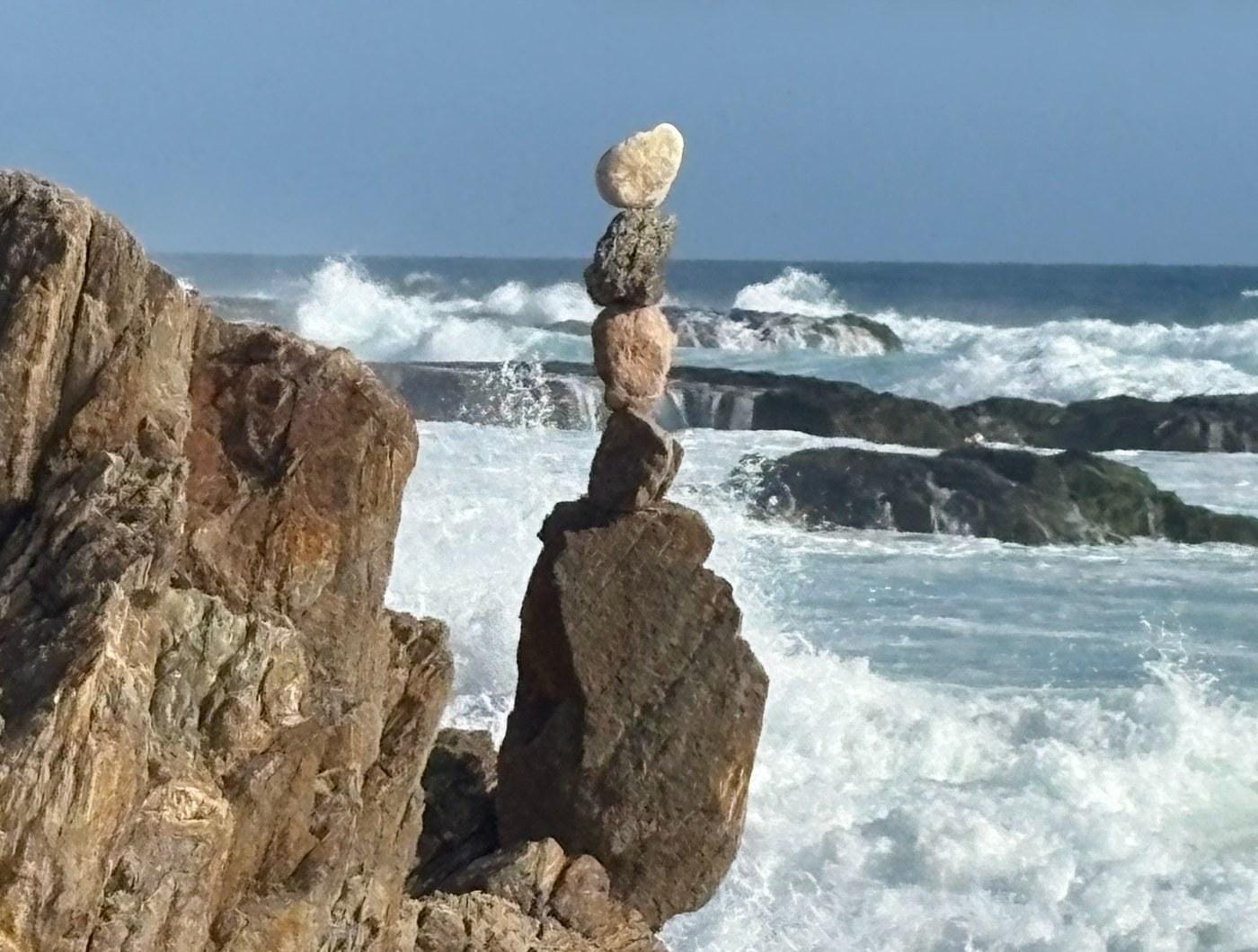
The Still Point. Baja California Sur.
The search has a sweet spot. Berlyne described its shape as an inverted U. I abandon rocks that are trivially stable, the near-cubes that offer no challenge, and I abandon those that are impossibly mismatched. What I hunt is the narrow band between them, where the difficulty sits just past my present skill. When difficulty and skill are matched that closely, attention has nowhere else to go. What Mihaly Csikszentmihalyi called flow arrives on its own. My ego dissolves into the task, not because I have willed it away, but because the task has left no room for it.
But the click, which feels so much like a destination, is not where the practice ends.
The Grace of the Collapse
Everything I balance falls. The wind takes it, or a wave, or a bird, or a passing walker, or nothing identifiable at all - I have watched a structure stand for an hour in still air and then simply collapse. For a long time I thought of the fall as the end of the episode. I have come to understand it as the center of the practice.
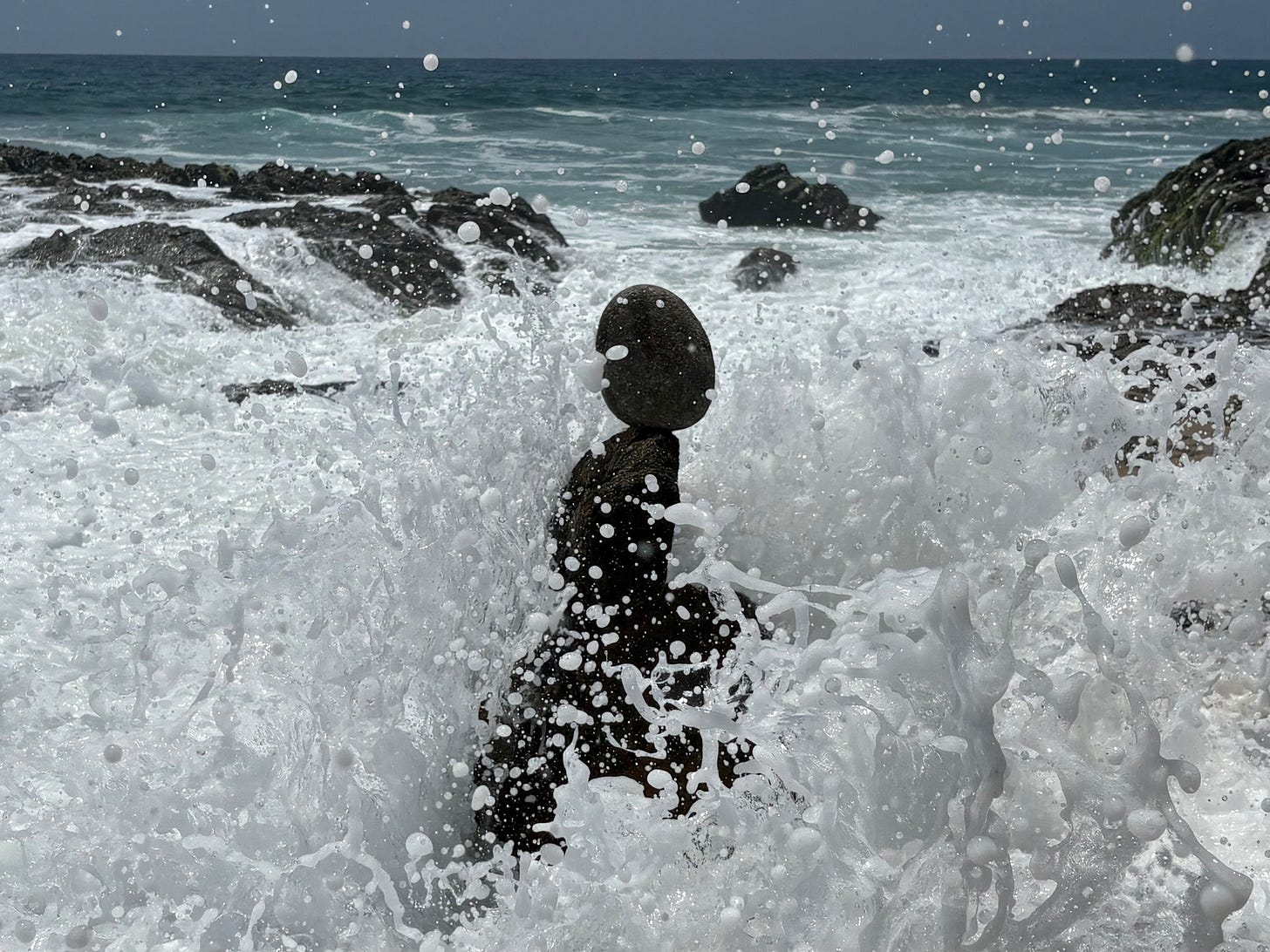
The click teaches me that I can find an answer. Only the collapse teaches me that the answer was never mine to keep. Every balance I have ever made was on loan, and the term of the loan was never disclosed. This is not a metaphor I impose on the rocks afterward. It is the plain fact of what happens on that shore every day, and the fact has worked on me slowly, the way water works on rock.
The discipline is in the response. There is the collapse I caused - I misread the rocks, forced a contact point, wanted it to work - and there is the collapse imposed by outside elements (the weather, the waves, the birds, etc.). The essence of the practice is that they receive the same response from me. Both are data rather than defeat. Neither one tells a story about my competence or about the unfairness of the world. Standing on the sand with my rocks scattered at my feet, I notice how quickly my mind wants to categorize the event as something; explain the reasons why. Now, I notice how much steadier I am when I decline to do so.
I take a photograph, and then I let the answer expire. I do this less often now than I once did. In the early years I documented nearly every balance, which I recognize in hindsight as an attempt to make the temporary permanent. These days I sometimes stand, and look, and walk on. This is practicing equanimity in the face of forces I cannot control - gravity, time, and change. I am not sure there is any way to practice it other than repeatedly, in small doses, on an ordinary morning.
Then, having lost the answer, I am returned to the beginning. I do not know again. This is the part I did not anticipate when I started: the fall is not the end of the cycle but the opening of a fresh information gap. Something in me quickens rather than sinks. The shoreline becomes wide again. I browse, I scroll - the wave, the bird, the shell, the light - until another rock catches my attention and the world narrows once more.
That is the whole loop: browsing, then seeking, then the click, then the collapse, then browsing again. The shore triggers it several times each morning. Diversive curiosity gives way to specific curiosity, specific curiosity finds its answer, the answer expires, and the wide-open attention I began with is handed back to me.
Beginning Again
You will not find a shoreline in most of your days, and the collapses that matter to you will not be made of stone. A role ends. A plan you built carefully comes apart in weather you did not forecast. Something you assembled with real skill and real attention stands for a while, and then does not.
What the small collapses have taught me is that the recovery is less a matter of resilience than of curiosity. Despair asks no questions; it has already concluded. What the stones have trained in me is the capacity to reach down, pick up something unfamiliar, and become genuinely interested in what might balance now. The gap opens again, and I find I am willing to stand inside it. Beginning again is not the consolation prize of a practice like this one. It is the practice.