
I’ve done several beach clean ups in the past few weeks
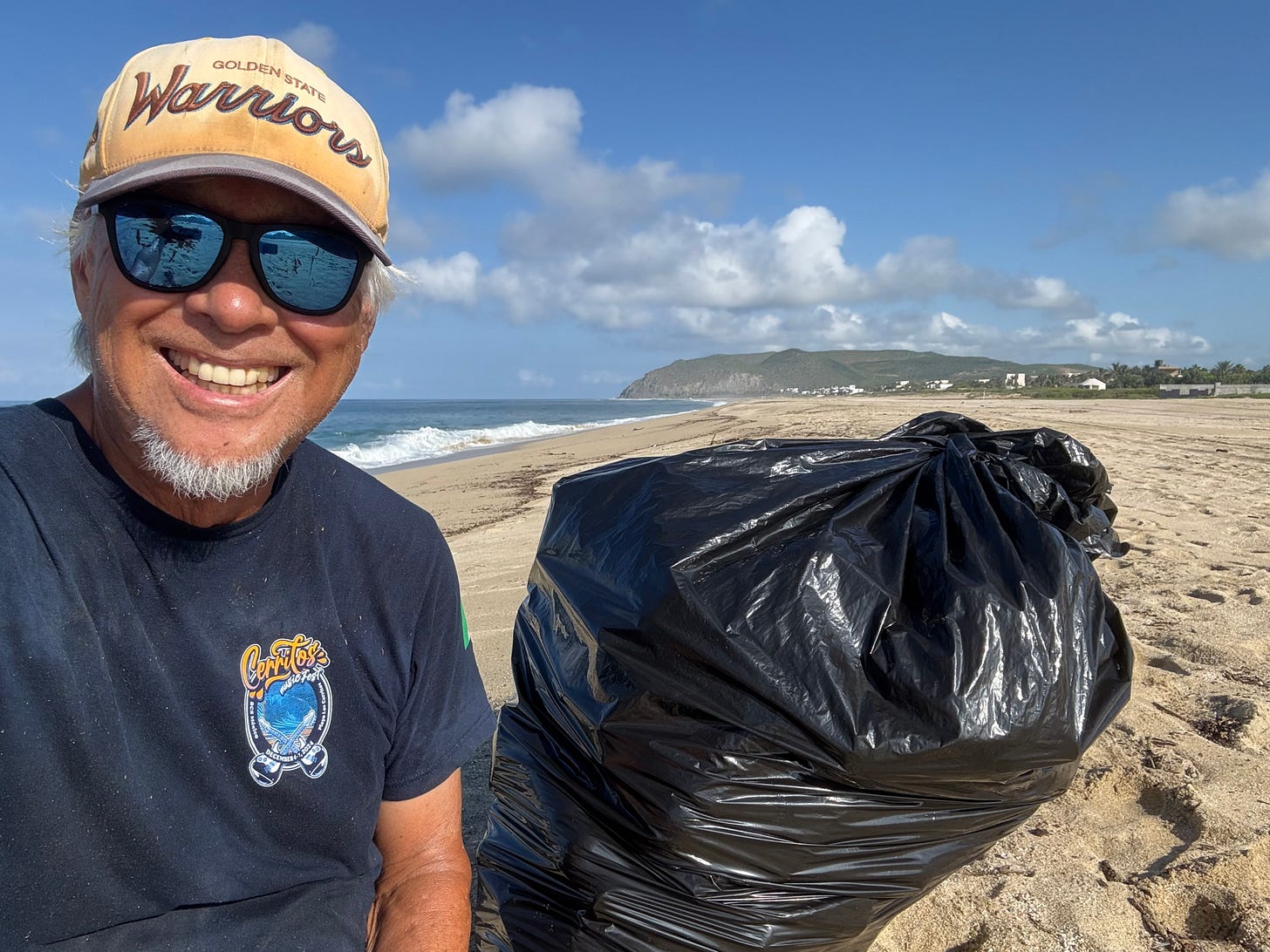
Recent rains have washed thousands of bottles, construction scraps, wrappers, and assorted pieces of broken plastic onto Playa Pescadero in Baja California Sur, Mexico.
I wound up picking up mostly the large pieces - the bottles, chunks of styrofoam, and broken containers - leaving the countless little shards, bottle caps, food wrappers, etc. in the sand to be washed into the ocean with the tide or the next rain.
I became curious about what happens with all this plastic as it gets broken down by the ocean. When I asked ChatGPT about this, it became clear that we might be in a long-term pattern that might not be good for future generations. Here’s what ChatGPT had to say when I asked it to extrapolate from the present into the future:
The World We Drift Into: Microplastic DystopiaBy the early 2030s, physicians speak routinely of the “background plastic load”—the invisible snow we breathe indoors, the grit in bottled water, and the residues found in placentas and arterial plaque. A landmark cohort study revealed that patients with detectable polyethylene and PVC fragments in carotid plaque were 4.5 times more likely to suffer a heart attack, stroke, or death within three years, prompting medical journals to describe plastics as a “new frontier” of cardiovascular risk1.
Open a bottle of “purified” water and you ingest the future: an average liter now contains roughly 240,000 plastic particles, mostly nanoplastics, far exceeding earlier estimates2. These particles cross biological barriers, with studies detecting them in blood, organs, and even human brains3. While official advisories remain cautious, clinicians privately opt for stainless steel bottles.
On maternity wards, pathologists quietly add new intake forms. Recent research has found microplastics in 100% of examined placentas and even in fetal cord blood4. Laboratory work shows that airborne particles can inflame placental tissue within minutes5. Neonatologists, faced with rising rates of unexplained complications, increasingly question whether “baseline exposure” exists at all.
Meanwhile, the “plastic weather” matures. Tire wear and textiles shed into alpine snow; ocean spray lofts particles back into the atmosphere. Inhalation—once a secondary concern—emerges as a dominant route of exposure. People may inhale tens of thousands of particles daily, with concentrations highest in car cabins and sealed apartments6. Autopsies confirm plastics lodged in lung tissue7.
Systems Start to Slip
Oceans and Climate
Microplastics glue themselves into “marine snow,” altering the ocean’s biological carbon pump. Instead of sinking, plastic-laden flakes remain buoyant, disrupting carbon sequestration and amplifying climate feedbacks8.
Soil and Food
Wastewater treatment plants successfully trap plastics—but in sewage sludge, much of which is spread on farmland. By one estimate, tens to hundreds of thousands of tonnes of microplastics are applied to European soils annually, with similar trends in North America9. This alters soil porosity, water retention, microbial communities, and potentially contaminates crops and groundwater.
Health and Economics
Marine plastic already imposes measurable costs. A widely cited analysis estimated damages to ecosystems and human well-being at thousands of dollars per tonne of plastic per year10. With cardiovascular and neurological risks added to the ledger, plastics could impose annual health costs exceeding a trillion dollars globally, forcing insurers to raise premiums in high-exposure industries.
Secondary Consequences
Cardio-metabolic burden. Small relative risks (e.g., 4.5× odds of vascular events) compound across aging populations, leading to earlier strokes and more hospitalizations1.
Reproductive headwinds. Persistent detection in placentas and cord blood, coupled with lab evidence of rapid inflammation, raises fears of infertility, preeclampsia, and growth restriction45.
Food chain distortions. Altered marine snow dynamics stress plankton and filter feeders, lowering fishery yields and increasing protein insecurity8.
Soil degradation. Plastic-laden biosolids reduce soil water retention, worsening drought impacts9.
Indoor-air inequality. Synthetic furnishings and poor ventilation concentrate microplastic aerosols in low-income housing and factory settings6.
Tertiary Consequences
Insurance & finance. Fisheries, aquaculture, and food processors face “uninsurable” risks unless costly filtration is installed10.
Trust erosion. Bottled water companies face lawsuits as consumers learn their “purest” products contained the highest nanoplastic counts2.
Policy whiplash. Failed global treaties trigger unilateral bans and trade disputes, snarling packaging and medical supply chains11.
Climate rebound. Weakened ocean carbon sinks force steeper emissions cuts elsewhere, diverting political will away from other crises8.
Why This Future Holds TogetherExposure is rising. Plastic production is projected to nearly triple by 2060, with less than one-fifth recycled12. Even if production ceased today, fragmentation ensures nanoplastics would continue increasing.
Biological pathways exist. Plastics cross biological barriers, inflame tissues, and embed in organs, plausibly amplifying chronic diseases135.
Systems coupling multiplies effects. Oceans, soils, and air act as reservoirs, ensuring plastics persist and cycle through all ecosystems89.
A Narrow Path of Defense
Cap production through global treaties—otherwise recycling and waste control cannot keep pace12.
Set sludge standards to prevent farmland contamination9.
Ventilation and filtration for indoor spaces, especially schools and factories, to reduce inhalation exposures6.
If these measures fail, the dystopia outlined above is not alarmist. It is simply the curve we are already tracing.
Footnotes
Chen, Y., et al. New England Journal of Medicine (2024). Study linking microplastics in carotid plaque with cardiovascular risk. ↩ ↩2 ↩3
Mason, S. A., et al. Proceedings of the National Academy of Sciences (2023). Nanoplastic counts in bottled water averaging 240,000 per liter. ↩ ↩2
Leslie, H., et al. Environment International (2022). Detection of microplastics in human blood and organs. ↩ ↩2
Ragusa, A., et al. Environment International (2021). Microplastics detected in human placentas. ↩ ↩2
Braun, T., et al. Nature Communications (2023). Placental inflammation triggered by airborne nanoplastics. ↩ ↩2 ↩3
Vianello, A., et al. Nature Communications (2019). Estimates of daily inhalation of microplastics. ↩ ↩2 ↩3
Amato-Lourenço, L. F., et al. Science of the Total Environment (2021). Microplastics in human lung tissue. ↩
Kane, I., et al. Nature Geoscience (2020). Microplastic interactions with marine snow and carbon flux. ↩ ↩2 ↩3 ↩4
Corradini, F., et al. Science Advances (2019). Microplastic contamination of soils via biosolids. ↩ ↩2 ↩3 ↩4
Beaumont, N. J., et al. Marine Pollution Bulletin (2019). Economic costs of marine plastic pollution. ↩ ↩2
UN Environment Programme (2024). Reports on failures of global plastics treaty negotiations. ↩
OECD, Global Plastics Outlook: Policy Scenarios to 2060 (2022). Projection of tripling plastic production and waste. ↩ ↩2