
I’ve been a Certified Financial Planner (CFP) for nearly 40 years. After a lifetime sitting across the table from clients asking me “What should I do?”, I have come to believe that the most honest answer is rarely a prescription. It is a perspective.
The perspective is this: think in possibilities, not pronouncements. Assign probabilities with humility and without vanity. And keep returning to a disciplining, yet empowering question — what if I’m wrong?
This is not a refusal to be useful. It is a refusal of the particular kind of false confidence that wealth management and financial planners are too often asked to perform. Forecasts misread. Regimes change. The single tidy sentence a client wants to hear — “the debt will collapse,” “the debt doesn’t matter” — is almost always less useful than a careful consideration of what could happen, with rough weights attached, and a plan that holds up across more than one of those futures.
The national debt is a useful test case for this approach. Few topics provoke more confident sentences from people who have not actually thought through the alternatives.
The debt is a landscape, not a verdict
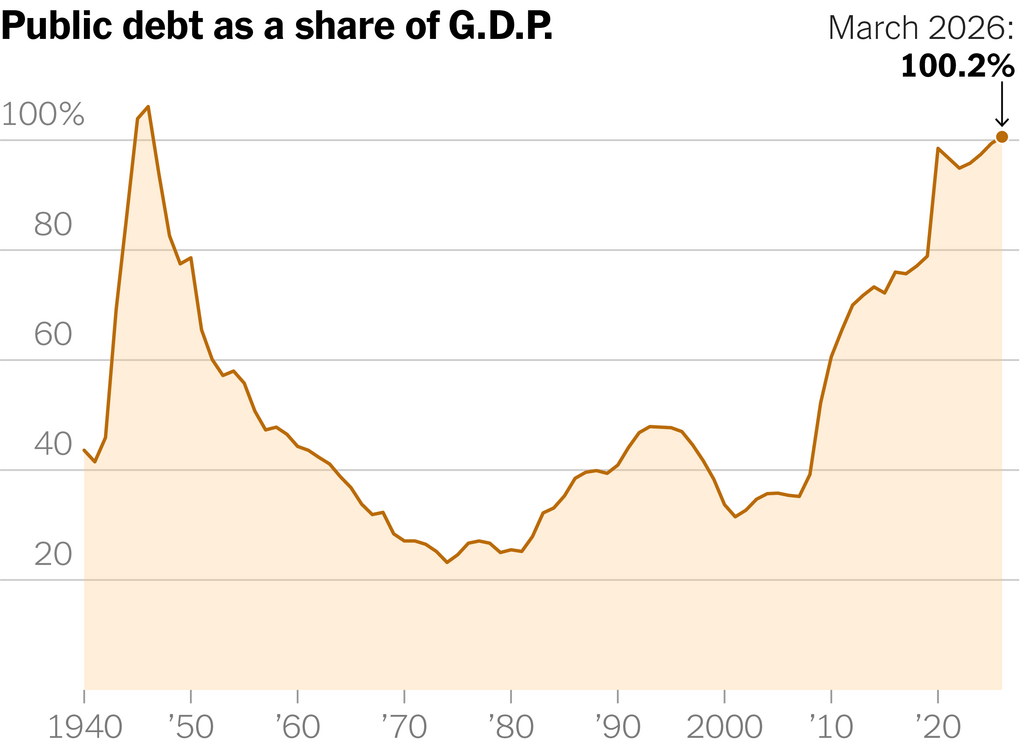
The numbers, taken at face value, are sobering.
Source: The New York Times
The Congressional Budget Office projects that debt held by the public rises every year from 2025 to 2055, reaching roughly 156 percent of GDP by then under current law. Interest costs are now central to the fiscal picture rather than a footnote. An aging population inevitably points to sustained pressure on Social Security, Medicare, and the rest of the age-related budget.
But facts require interpretation in order to lead to action. The same numbers underwrite very different stories.
One story says the United States is drifting toward serious fiscal trouble — chronic strain at best, an eventual rupture at worst. Another says debt fears are overstated because the United States borrows in its own currency, runs the world’s deepest capital market, and still benefits from the dollar’s reserve role. Both stories cite the same data. Both are partly true. Neither is sufficient.
The mistake on either side is the same mistake: treating the debt as a verdict already delivered rather than a landscape that can evolve in more than one direction.
A landscape has terrain. It has constraints, vulnerabilities, and choices. It is not a single road leading to a single destination. The structural forces — demographics, interest costs, political incentives, productivity, the behavior of foreign holders — interact over decades, and they produce branching paths rather than a single outcome.
Four scenarios and one wild card
When I work through this, I can sketch four plausible paths and one modifier.
Managed adjustment. Policymakers eventually respond — some combination of higher revenues, slower spending growth, entitlement reform, technical adjustments to eligibility and benefits. The debt ratio remains high, but the path becomes less explosive than current projections imply. This is the scenario most long-term models implicitly assume, on the theory that visible fiscal pressure eventually produces at least partial response.
Inflation tilt and quiet repression. The more politically tempting path. Rather than enact visible reform, policymakers tolerate periods of somewhat higher inflation while institutional and regulatory pressures keep real borrowing costs lower than an unconstrained market would set them. It results in years of disappointing real returns for cautious savers, and a slow erosion of the real value of debt. Its burdens are diffuse — many households absorbing small losses in purchasing power — which is precisely why it is attractive to political systems that prefer hidden costs to visible ones.
Late, stress-driven adjustment. Procrastination followed by compulsion. Inertia continues until a recession, a rate spike, or a downgrade forces sharper changes than would have been needed earlier. This is not necessarily a sovereign crisis. It can look more like sudden tax hikes, abrupt benefit trims, emergency budget deals. Adjustment under duress is almost always harsher and politically uglier than the same adjustment undertaken deliberately.
Genuine fiscal crisis. The lowest-probability, highest-impact path: a real loss of confidence in U.S. fiscal management, with sharply higher yields, severe market dislocation, or a destabilizing inflation surge. Prediction markets currently price an outright default before 2027 in low single digits. They price another debt downgrade meaningfully higher. The trading crowd, in other words, is pricing continued strain with episodic turbulence — not imminent collapse.
The wild card: a productivity surprise. This is the modifier that reshapes every other scenario. If artificial intelligence, energy innovation, or some combination of technological advances materially lifts productivity over the next two decades, a high debt load becomes more manageable relative to a larger national income. The fiscal problem does not disappear, but the trade-offs soften and the politically feasible options widen. I weight this higher than most fiscal commentators do, because the asymmetry is large: even a modest sustained productivity gain meaningfully reshapes the debt dynamics, and the technological inputs to such a gain are visibly in various stages of development now.
None of these scenarios is destiny. Their value is not predictive. In this environment, one must keep their mind open to emerging, branching possibilities while resisting the craving for a single reassuring answer.
Probabilities without pretense
Once the scenarios are visible, a probabilistic posture becomes possible — without pretending to a precision that does not exist.
My own rough judgement, today, puts the highest emphasis on some blend of managed adjustment and inflation tilt. A meaningful but smaller weight goes to delayed, stress-driven adjustment. The smallest weight, never zero, goes to a genuine rupture. The productivity surprise sits across all of these as an upside modifier — it does not replace the others, but it can soften any of them.
These weights matter less than the practice of holding them lightly. The honest version of probabilistic thinking is: here is what I think is more likely, and here is how much I am willing to bet against being wrong. The dishonest version is precision masquerading as analysis — statistics attached to a guess.
The central question is no longer whether the debt mechanically produces catastrophe. It is what kinds of chronic pressures and episodic disruptions become more likely in a world where debt, demographics, interest costs, and productivity interact over decades — and how a family, a household, a small community can be designed to live well across that range.
What if I’m wrong?
This is the discipline that conventional advice lacks.
Conventional advice often masquerades as certainty that reality does not justify. I once had a colleague who used to brag that he was “Sometimes wrong but never in doubt.” Like many, he would pronounce that This will happen, therefore do that. When the future is fundamentally uncertain, that style protects the authority of the adviser more than the welfare of the client.
The more useful discipline is to ask, of every judgment: what happens if I am wrong about this?
If I underestimate inflation, a household concentrated in long-duration nominal assets can quietly lose a decade of purchasing power. If I overestimate the risk of fiscal crisis, a household that stays defensive for ten years can forfeit the compounding that makes a long retirement workable. If I treat current retirement promises as politically untouchable, plans built on those assumptions become brittle for younger or higher-income households whose benefits may yet shift.
The point of asking what if I’m wrong? is not to paralyze decision-making. It is to make it more truthful, and to design plans whose failure modes are tolerable rather than catastrophic.
This is, of course, still a form of advice. It is meta-advice — advice about the perspective from which any specific decision should be made. From that perspective, particular decisions become easier and more honest, because they are no longer asked to predict the future. They are asked only to remain workable across more than one of its versions.
From resilience toward antifragility
Nassim Taleb introduced the concept of antifragility more than a decade ago, in the 2012 book of that name. His distinction is simple: a fragile thing is harmed by volatility; a robust thing resists it; an antifragile thing, in the right doses, actually gains from it. Muscles strengthen under stress. Immune systems develop through exposure. Some systems thrive on the very disorder that destroys others.
I want to use Taleb’s term carefully, because it is often loosely applied — including, at times, by me. Most of what passes for “antifragility” in financial planning is really resilience plus optionality: the ability to survive turbulence and to act on it when others cannot. That is valuable, and most clients would benefit from more of it. But true antifragility, in Taleb’s strict sense, requires asymmetric exposure — limited downside, meaningful upside — and the willingness to absorb many small losses in exchange for occasional large gains. That is a stronger claim than most lifestyles can comfortably accommodate.
For most households, the right aspiration is a position that is robust with antifragile tilts: a financial life that does not require any single regime to hold together, with a few elements designed not just to survive disorder but to compound through it.
What that looks like in practice depends on the household, but a few patterns recur.
Liquidity becomes more than a safety cushion when it is held with intention. Cash that exists only as a hedge against fear is essentially dead weight. Cash that exists, in part, to acquire quality assets when volatility creates dislocation has become a form of optionality. The reserve protects against fragility while preserving the ability to act when others must retreat.
Career capital often matters more than financial capital over a long-term horizon. Skills that travel across sectors, wisdom and judgment that holds up under unfamiliar conditions, networks that survive job changes — these gain value precisely because the environment is unstable. A career organized around one specialty or one employer’s stability is more fragile than it looks. A career organized around adaptability is closer to antifragile.
Retirement plans become more durable when they are built as ranges rather than points, with diversified tax buckets, flexible spending rules, and conservative assumptions about benefits. The goal is not to predict which features of current law will hold; it is to construct a plan that does not require any one feature to hold.
And the deepest forms of optionality are usually not financial at all. Health, relationships, local community, purposeful activity — these reduce dependence on any single institution or forecast. They are the parts of a life that no policy regime can quietly tax or legislate away.
Antifragility, even modestly understood, does not promise that pain disappears. It only changes the meaning of disorder. Under the right conditions, what would otherwise be only a threat also becomes a source of opportunity, adaptation, and renewal.
Why this is not really about the national debt
The national debt appears to be about fiscal policy. Beneath that sits the larger question of how to make long-horizon decisions when the systems that govern those decisions are both consequential and inherently unpredictable.
The debt matters because it is a long-duration signal — about promises already made, burdens likely to be shifted forward, and the room future governments may have to act. It also illustrates a pattern that recurs across the most consequential risks in life: they tend to move slowly long before they become visible enough to demand attention.
The right response to that kind of risk is neither denial nor melodrama. It is disciplined imagination — the willingness to hold more than one future in mind at once, to assign rough weights without pretending to precision, and to keep designing for the question of what kind of life can flourish even when the forecasts turn out to be incomplete.
That, finally, is the work. Not prophecy. Design.
Build savings that preserve flexibility. Build portfolios that can live through more than one regime. Build careers that gain from change. Build retirement plans that account for the possibility that the rules will move. Build a life that is not so optimized for one version of the future that it shatters when reality arrives in another form.
That is what not giving advice actually means, in the end. Not a refusal of responsibility. A refusal of false certainty — and an invitation to a more honest practice. Possibilities, probabilities, and what if I’m wrong? are not a retreat from judgment. They are the discipline that makes judgment trustworthy across a horizon long enough to matter.
Notes
1. Congressional Budget Office, The Long-Term Budget Outlook: 2025 to 2055 (Washington, DC: CBO, March 2025).
2. Polymarket, “US defaults on debt by 2027?” prediction market, accessed May 2026.
3. Polymarket, “Another US debt downgrade before 2027?” prediction market, accessed May 2026.
4. Nassim Nicholas Taleb, Antifragile: Things That Gain From Disorder (New York: Random House, 2012).